
How to Create an Acting CV
An acting CV fits on one side of A4 and lists your contact details, vitals and age range, your film, television and theatre credits with most recent first, your training, and special skills you can do on demand. Never lie, never list extra work, and leave your home address and your exact age off.

An actor's CV, along with a headshot and showreel, is your calling card. It is there not only to show off your experience and past work, but also your training, physical stats and any other skills you have.
When you are first starting out, you will not have many credits, and that is completely fine. We all started somewhere, and you can still have an acting CV you are proud to hand to any casting director or agent. No one expects you to have a lot of work yet. On the other hand, how you present yourself is very important. That means including the relevant information, spell-checking, formatting, and making sure your CV is polished and presents you as a trusted, professional actor, ready for anything a director can throw at you. Here is what to include.
Acting CV basics
- Keep your CV clean and easy to scan.
- Do not add every role you have played since you started speech and drama as a child. Add the relevant productions from the last five to ten years.
- Your CV should be no longer than one side of A4. No one reads page two, so put your most distinguished credits on one page and lose the rest.
- Use a standard 12-point font size.
- Use a simple font such as Times New Roman or Arial.
- Never lie on your CV. It is a small community, and you do not want to damage your reputation. Nothing is more irritating for a casting director than giving you a valuable audition slot on the understanding that you can drive, as stated in the skills section of your CV, only to find out that you have just had your third driving lesson.
- Do not put extra work on your CV.
Contact information
If you have an agent representing you, add their email address and phone number. If you represent yourself, include your own email address and phone number. Just make sure the email address is professional; perhaps keep tuttifruity01@gmail.com for friends and family.
We advise leaving your home address off your CV.
Vitals
Add your height, weight, hair colour, eye colour and age range. Never put your actual age on your CV unless you are under 18. Your age range should not be broader than ten years: if you are 38, your age range might be 33 to 43. If you want to do musical theatre, list your vocal type here too, for example "Voice: Tenor".
A vitals line on a CV looks like this:
Height: 5′8″ (173 cm) | Eyes: Brown/green | Hair: Brown | Playing age: 25 to 35
Credits and experience
This covers any performing experience on film, television or in theatre: student films, short films, music videos, plays, community theatre and so on.
Group this section into Film and Television, and Theatre. In each, list your most recent jobs first.
Film and television
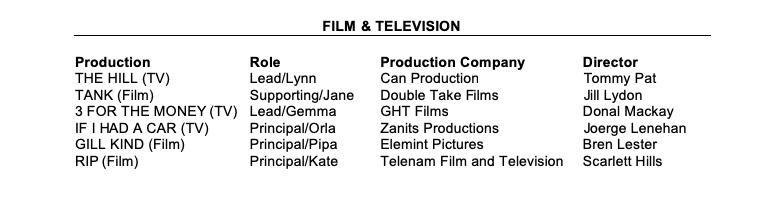
List the name of the show or film, followed by your character's name, the network or production company, and then the director.
Do not ever put extra work on your CV. Again: do not ever put extra work on your CV.
What the role types mean
Casting directors read a CV quickly, and the size of each part tells them more than the title of the production. These are the terms you will see on breakdowns and can use on your CV:
- Lead: the role the story follows; you are in most of the scenes.
- Supporting: a named character with an arc of their own who appears across several scenes, such as the best friend, the parent or the rival.
- Principal: the Irish and UK term for any speaking role that is not the lead, from a single line up to a large supporting part. In commercials, principal means the featured performer the ad is built around.
- Co-star and guest star: American television terms. A co-star is a small speaking part, usually a few lines in one episode; a guest star is a larger part that drives an episode's story, often for a single episode or a short run.
- Recurring: a character who returns across several episodes without being a series regular.
- Featured: a non-speaking part that is clearly seen on camera, for example a shopkeeper the lead talks to without a reply. It sits above background work but below principal.
- Extra or background: no lines and no focus on you. It does not go on your CV.
On a film or television credit, put the character name rather than the role type, and use the type only where it adds something, for example "Lead" on a short film or "Guest star" on a series.
Theatre
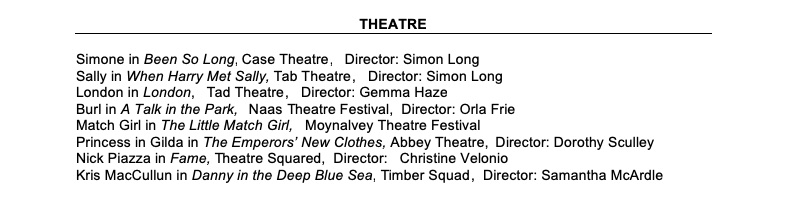
For the theatre section, list the name of the play, followed by your character's name, the theatre or theatre company, and the director.
Training
Add any performance-related training: acting, singing, dancing and so on. If you took a workshop or short intensive course, include the specifics of what you learned. If you list a dance class, say which style (ballet, tap, jazz). For acting, specify the type of training (scene study workshop, audition technique masterclass, Meisner technique workshop).
If you went to college, list the name of the college, followed by the course name and the year you completed it, for example: The Irish Academy of Performance, Full-Time Performing Arts Programme, 2018.

Special skills
These should be things you can do well, and right away if asked. If you say you are a boxer, you should know how to box. You can include your level, for example "Piano (intermediate)". Add the languages you speak, and say whether you hold a full, clean driving licence.

This section also covers accents. It is a good idea to add an asterisk beside your own natural accent, for example: Accents: Irish-Standard*, Belfast, Irish-Northern, Cork, RP, American-Standard.
As well as your paper CV, your Actorly profile holds your headshots, credits, training and skills in one place, and it is what a casting director sees when you apply to a casting. You do not have to type it all in again: upload your CV when you edit your profile, and Actorly's AI reads it and fills in your credits, training and skills for you to check, which saves a good deal of time. It is free to join and free to apply. Create your free actor profile and start applying today.
Frequently asked questions
How long should an acting CV be?
No longer than one side of A4. No one reads page two, so put your most distinguished credits on one page and lose the rest. Use a standard 12-point size in a simple font like Times New Roman or Arial.
Should I put extra work on my acting CV?
No. Do not put extra or background work on your acting CV. List your performing credits in film, television and theatre, including student films, short films, music videos, plays and community theatre.
Should I put my age on my acting CV?
No, unless you are under 18. Give an age range instead, no broader than ten years. If you are 38, for example, your age range might be 33 to 43.
What goes in the special skills section of an acting CV?
Things you can do well, and right away if asked, such as sports, instruments with your level, languages, and whether you hold a full, clean driving licence. It also covers accents; put an asterisk beside your own natural accent.
What do I put on an acting CV with no experience?
Your training, vitals, special skills and any student films, short films, plays or community theatre you have done. No one expects a lot of credits when you are starting out, but a clean, well-formatted, spell-checked CV still presents you as a professional.
Casting directors post their castings on Actorly.
Build a profile in minutes, get casting alerts matched to your playing age, and apply for free.
More from the blog
 For actors
Acting Cover Letter: Template and Tips
How to write an acting cover letter to an agent or casting director: keep it short, address a named person, mention recent work, and a sample letter to adapt.
 For actors
How to Build a Great Showreel
How to build an acting showreel: what to include, how long it should be, what to do when you have no footage yet, and how to film scenes at home.
 For actors
Casting Directors in Ireland: What They Do and How to Get on Their Radar
What casting directors in Ireland do, how to approach them with a headshot, CV and showreel, and a list of Irish casting directors with live websites.